
Four things, in this order.
We start at the machine, because that is the part we are already responsible for, and we only go further if there is something worth going further for.
Capture, set up properly
Scan destinations that go to the right folder and the right person, file names that make sense a year later, two sided and searchable by default. Included with every machine we supply, and we will do it on the machine you already have.
The archive behind you
The filing cabinet nobody opens, and the drive full of files called scan0001. We can work out a structure that suits how your business actually looks things up, then get the paper into it.
One process, joined up
Not your whole business. One job: the invoice that gets rekeyed, the docket that gets chased, the form somebody retypes. Scoped, quoted, built, handed over with a note explaining how it works.
Nothing to buy from us
We do not sell you a document system and we do not take a margin on one. If the tools you already pay for will do it, and they usually will, we use those.
What most offices actually have
A multifunction machine that cost real money and scans beautifully. One button on it marked Scan to Email, which everybody uses, because it was the only one anyone set up. A shared drive with four folders called Scans, Scanned, To File and New Folder. An archive of paper in a room, indexed by whoever put it there. And one person who knows where everything is, which works perfectly until the day they are on leave.
None of that is a software problem. It is a setup problem, and it has been sitting there since the machine was installed.
Where we start
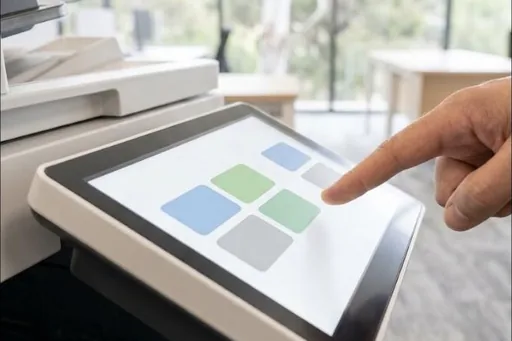
At the machine, on the day. A scan should land where the work happens, not in a tray somebody empties on Fridays. So we set up destinations per department or per person, file names that carry a date and a reference rather than a counter, the right format and resolution for what it is, and two sided as the default because that is what people forget. Then we stand next to the person who scans the most and watch them use it, because a destination nobody presses is not a destination.
This is included when we supply a machine, and we will do it on a machine you already own as part of a service visit.
Where it goes after that
Only if there is something worth doing. Most offices have one job that quietly costs a day a month: the supplier invoice that arrives as a PDF and gets typed into the accounts system by hand, the delivery docket that has to be matched to a job, the signed form that goes into a folder and then into a spreadsheet, the same email written forty times a week with two words different.
That job is what we look at. We scope it, tell you what it would cost to fix and what it is costing you now, and if it is worth doing we build it, test it with the person who does the job today, and hand it over with a written note of how it works so it is not a black box.
One process at a time, deliberately. A supplier who offers to redesign how your business runs is selling you a project. We would rather fix the thing that is actually annoying you and let you decide whether there is a second one.
What we will not do
We will not sell you a document management platform with a seat count and a minimum term. That model has been sold to Australian businesses for twenty years, and a lot of what it delivered was scanning to a folder at a price that had a licence wrapped around it.
We will not build something only we can maintain. Whatever we set up, you own, on your own accounts, and you can take it to somebody else or unpick it yourself. We write down what was built and why.
We will not tell you a process needs automating when it does not. Plenty do not. Some are rare enough that a person doing it by hand is the right answer, and we will say so, because the alternative is you paying us to build something you use twice a year.
Why ask a copier company
Two reasons, and the second is the honest one.
The first is that we are the only supplier in the building who sees the paper. We know what that machine scans, what it prints and what it copies, because we look after it. Nobody has to explain to us where the volume is.
The second is that we built this for ourselves before we offered it to anybody. Our own enquiries, jobs, machines, invoices and meter readings run through connected systems rather than a person retyping them, including the part of our month that used to be somebody reading numbers off a report and typing them into a spreadsheet. It is not a demonstration we set up for sales calls. It is how the company works, and it is the reason we know which of these jobs are worth automating and which are not.
Who this suits
Small and medium businesses. Offices of roughly five to fifty people with a real amount of paperwork and no in house systems person: accountants and bookkeepers, legal and conveyancing, medical and allied health, construction and trades, transport, real estate, schools and community organisations.
It suits you least if you already have an internal systems team or a document platform you are committed to. In that case the useful thing we do is the capture at the machine, done properly, feeding whatever you already run. We are happy to be that and to leave the rest alone.
Getting the machine at the same time
Most of this starts because somebody is looking at a new copier anyway. If that is you, it is worth doing together: the machine is sized to what you actually print and scan, the capture is set up on day one rather than two years later, and the whole lot can sit inside one arrangement. Machines can be bought outright, rented, leased or financed, and we take the old one away.
See the machines Rental and lease Ask for a quote
Common questions
Do we have to buy software from you?
No, and we do not sell any. Where the tools you already pay for will do the job, which is most of the time, we use those. If something new is genuinely needed you buy it directly on your own account, not through us.
Do you have to have supplied our copier?
No. The capture setup can be done on whatever machine you have, as part of a service visit. It is included when we supply the machine, which is the only difference.
What does it cost?
The setup at the machine is included with a machine we supply and is part of a service visit otherwise. Anything beyond that is scoped and quoted in writing before it starts, so you see the cost and what it replaces before you decide.
What if we already have a document system?
Then we leave it alone and do the part in front of it: getting the paper in, named properly and landing in the right place. That is usually the weakest link anyway, and it is the part we are already responsible for.
Who owns what you build?
You do. It sits on your own accounts, in your own systems, and we write down what was built and why, so you or anyone else can pick it up. We do not build things only we can maintain.
Is our information safe?
Anything we set up runs inside your own systems and accounts rather than ours. Where a technician needs access to do the work we ask for the least that will do the job, and we tell you what it was. Worth knowing separately: a copier keeps what it scans and prints on an internal drive, which is why we raise clearing it before a machine ever leaves your office.
How small is too small?
If one person spends an afternoon a month on the same piece of paperwork, it is worth a conversation. If it happens twice a year, it is not, and we will say so.
Software and services named by a customer are their own, and naming one says nothing about any relationship between us and its maker. Anything we build is scoped and quoted in writing before it starts.